
Many of us like poetry. How did poetry come about you ask?
Well the Norse people have an interesting legend about ‘The Mead of Poetry,’ in the Prose Eddas.

Grab your comfy chair sit back and relax to hear this awesome Norse tale.
Back in the day, let’s go way back to an ancient, pre-Christian time of Norse god and godesses.
The story goes something like this….
There were two groups of Norse gods and godessess, one called the Vanir earth and water deities, they practice magic and the other was named Æsir.
After years of feuding they called for amnesty.
The two group solution was to spit in vats that magically created a wise skald or scholar named Kvasir meaning fermented berries.
The wise Kvasir roamed the countryside sharing his wisdom with the villagers.
One day he crossed paths with two cunning dwarves named Galar and Fjalar.
They were inventive little dwarves and decided to murder Kvasir.
They poured Kvasir’s blood into a cauldron named ‘Odrerir’ (mead of poetry) to create a delicious, fermented beverage stirred with the addition of honey calling it ‘The Mead of Poetry.’
The legend says, ‘Whoever sips this mead will transform into a Skald means Poet or Scholar.’
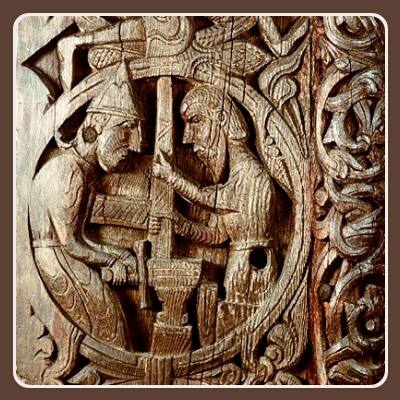
Fjalar and Galar cleverly invited a giant named Gilling for dinner. They sailed with him out to the sea then drowned him! The dwarves returned to tell Gilling’s wife the gory details. She began to weep and wail, Galar grew weary of her noise and released a millstone on top of her noggin! Ouch!
Suttungr her son found out about his parent’s death. He threatened to kill the murdering dwarves. They came to a peaceful agreement by giving Suttungr the mead of poetry. Suttungr hid it in cave ‘Hnitbjorg’ where his lovely daughter Gunnlod watched over it.
Meanwhile, Odin all-father heard this news through the grape vine. He quickly journeyed to Baugi, Suttungr’s brother’s place.
There Odin disguised as a field-hand named Bölverkr or Bolverk in English, means (Evil-doer) offered to sharpen the hay bailer’s blades. His whetstone was the best for sharpening their blades.
The field-hands all wanted to purchase this whetstone.
Odin aka Bolverk, threw the whetstone into the air. All the workers swirled their scythes into thin air and accidentally decapitated each other!
Baugi complained to Bolverk how the deaths of his workers negatively effected his business.
Odin/Bolverk, offered to finish the job if he could enjoy a draught of Suttungr’s mead of poetry.
Baugi agreed to his offer.
When the job was completed Baugi and Bolverk traveled to visit Suttungr to collect the draught of mead for Bolverk.
Unfortunately, Suttungr jealously guarded his mead and refused to share it.
Bolverk came up with a trick to give Baugi the drill called, ‘Rati’ so Baugi could drill into the side of the mountain Hnitbjorg where the mead of poetry was hidden.
After beguiling Baugi, Bolverk shape-shifted into a snake and slithered into the mountainside. Once there he helped himself to three draughts of the mead of poetry.
Odin/Bolverk then transformed himself as a handsome eagle.
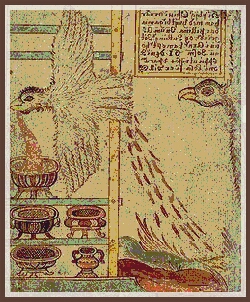
He flew out of the cave towards Ásgardr in English it is Asgard means (enclosure of the gods) where he was helped by the Æsir gods. They placed large bowls out so Odin then spat out the mead into the bowls. He was pursued by Suttungr who had also, morphed into an eagle.
He was close on Odin’s tail feathers. As Odin spit out the mead into the bowls some of the mead flew backwards and hit Suttungr right in the beak and changed him into a Skald.
Thank you to all the bees that contribute their tasty honey to mead.

Source & Reference:
- Snorri Sturluson,The Prose Edda, translated and edited by Anthony Faulkes, London: Everyman, 1995, ISBN 0-460-87616-3.
- Above, Stone Image: The Gotlandic image stone Stora Hammars III is believed to depict Odin in the form of an eagle (note the eagle’s beard), Gunnlöð holding the mead of poetry, and Suttungr. Public Domain.
- Featured image: Chased by Suttungr, Odin spits the mead of poetry into several vessels. Illustration by Jakob Sigurðsson, an 18th-century Icelandic artist.
- All illustrations and photos in Public Domain

 Nifty Buckles (Valerie Hopkins) Author of enchanted tales, folklore & magic • Once famously chased by vampire pumpkins. Brand Architect of The Darwind5 VAWT