
According to Norse mythology the trickster god Loki and the giantess Angrboða birthed a daughter and named her Hel or Hela which means concealer.
Hel is a sister to Fenrir the giant wolf and Jörmungandr, Midgard serpent. This misunderstood goddess of the shadow world is a queen that presides over a realm of the dead, where she receives a quota of the dead, ones that expired due to sickness or old age.
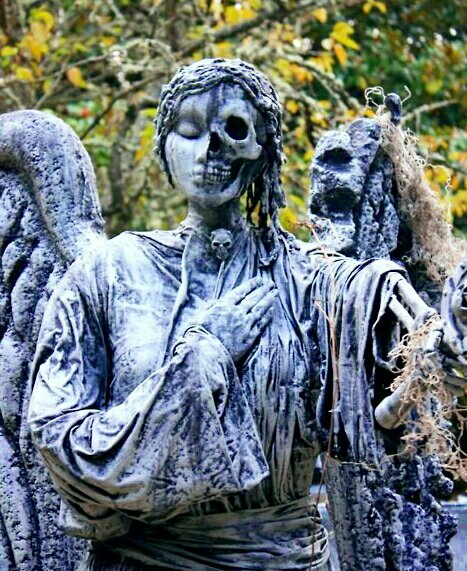
Hel is half blue and half white, she dwells in the dark world termed Niflheimr. Hel’s facial appearance has been noted as half woman, half skull. Hel’s body is described as a healthy woman neck to waist. Waist down her body is a decayed.
Éljúðnir is Hel’s hall, according to legend, Hel built herself a huge estate, the Drop of destruction. It includes Eljudnir, home of the dead from the nine worlds. Her servants were called, Ganglati and Ganglot. Hel even has names for her plate called “Hunger” and her knife is termed, “Famine.” Her bed is named “Sick bed” and her bed hangings called, “Glimmering misfortune.” the southern area of Hel is termed Náströnd means Corpse-world where oath breakers and law breakers are placed. The dragon Níðhöggr gnaws on these corpses as a dog chews its’ bone.
Freyja, the Norse Vanir goddess oversees a portion of the dead too in her afterlife field called, Fólkvangr.
Dead warriors that fought bravely in war are scooped up by the Valkyries and placed in Valhalla overseen by Odin.
Hel is mentioned in the Poetic Edda, composed in the 13th century from earlier traditional sources, and the Prose Edda, written in the 13th century by Snorri Sturluson. Hel is also cited in poems recorded in the 9th and 10th century, Heimskringla and Egils saga.
Hel is described as having been selected by Norse god Odin, to rule the underworld realm of the same name, located in Niflheim.
The Prose Edda details that Hel rules over vast estates with several servants in her shadow realm and plays a key role in the attempted resurrection of the god Baldr..”
Hel has a special trick up her sleeve, she can spread the plague with her broom.
Sources and Reference:
Dronke, Ursula (1969). The Poetic Edda 1: Heroic poems. Clarendon Press. Bell, Michael (1983).
“Hel Our Queen: An Old Norse Analogue to an Old English Female Hell” as collected in The Harvard Theological Review, Vol. 76, No. 2 (April 1983), pages 263–268. Cambridge University Press.
The Penguin book of Norse Myths Gods of Vikings by Kevin Crossley-Holland.
Statue of the Norse goddess, Hel in unknown cemetery.
Photo unknown artist in Public Domain

 Nifty Buckles (Valerie Hopkins) Author of enchanted tales, folklore & magic • Once famously chased by vampire pumpkins. Brand Architect of The Darwind5 VAWT