
The ‘Witches Broom’ has been linked to Old wives tales of medieval times. Mentioned more by paranoid Christians that attempted to connect the practice of herbal healing and midwifery to the Christian devil called Satan. A word to the wise, there is no devil in witchcraft. This misinformation caused hysterics leading up to the Witch trials across Europe and America. This Christian phobia stripped the Cunning woman of her healing work and herbal knowledge later handing her knowledge over to Allopathic medicine in which the pharmaceutical information became a mainly male dominated science thus the term ‘Doctor. ‘ Women were permitted to carry on as midwives and nurses however, it wasn’t until the twentieth century that women were allowed into the medical colleges to earn their Doctor’s diploma.
Shamanic journeys have been practiced since ancient times. One celebrated way to enter altered states of consciousness was by mixing psychoactive plants in tandem to craft a hallucinogenic balm, ointment or salve known as ‘flying ointment.’ Belladonna and Henbane made up the main ingredients in these salves. When witches applied this magical balm on their body it triggered wild hallucinations plus a narcotic trance.

Witches by Hans Baldung. Woodcut, 1508 (Public Domain)
The Neo-shaman and anthropologist Michael Harner reveals that the psychoactive effects of the ointment would increase if the salve was rubbed into the vaginal membrane by means of a broomstick or staff. This explains how this chemical effect would give the witch or shaman flights of fancy. These Chemical illusions help to explain tales of witches sabbats and ritual gatherings with demons or a devil. There is no mention of any accounts of accidental self-poisoning by witches using these flying salves.
This shows that the witch would have mixed the correct amount on a broom in order not to be poisoned by venomous plants such as Belladonna and Henbane. These plants can be lethal if there is too much used in making a flying balm.
What is clear from a number of reported cases, witches that used these toxic plants to concoct a homemade flying balm experienced overpowering trance-like states in which they or their astral bodies flew to sabbats. Shamanic practices were used in pre-Christian times among the Indo-European people as well as other cultures to venerate the nature goddess. Neo-pagans, Witches, Druids and other types of pagans have rediscovered the goddess once more and create a healthy balance of positive and negative energies.
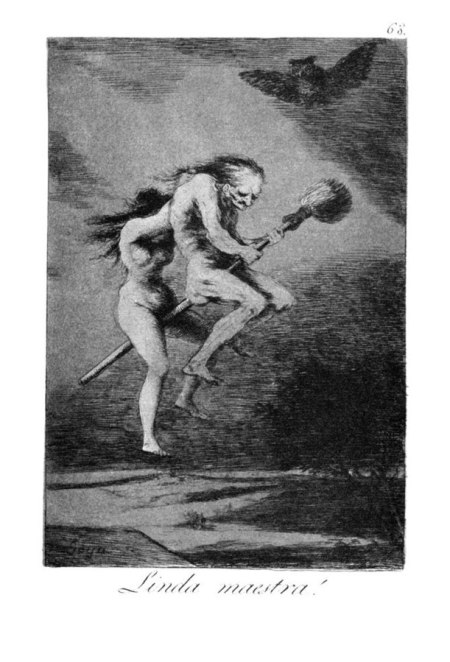
”Los Caprichos” is a set of 80 aquatint prints created by Francisco Goya for release in 1799 (Public Domain)
Source & Reference:
| Authors: | DG Scragg, Audrey L Meaney, Anthony Davies, S J Parker, |
|---|---|
| Publisher:
Book: |
Manchester Centre for Anglo-Saxon Studies, 1989.
Witchcraft and magic in Anglo-Saxon England, in Superstition and Popular Medicine in Anglo-Saxon England. |

 Nifty Buckles (Valerie Hopkins) Author of enchanted tales, folklore & magic • Once famously chased by vampire pumpkins. Brand Architect of The Darwind5 VAWT