Aah! Magnificent autumn with its dazzling scarlet and golden leaves falling gently around a tree. I recall my dad raking these same leaves only to turn around and watch my sister, myself and our friends dive into them with glee. Thankfully, my dad was a good sport about it.
This year Halloween on the Gregorian calendar, arrives on Thursday, October 31st to Friday November 1st.
However, because of Christianity’s Gregorian Calendar moved Samhain’s original date, neopagans that wish to discard the old Christian dogmatic calendar and revel in a breath of fresh air that enhances the sorcerer/enchanter’s magic will want to chose the best time of Samhain’s festival: Pagans need to secure its supreme supernatural juncture which begins on the night of the full moon before October 31st and ends on the New Moon after October 31st. It is believed that Samhain’s original festival fell around the lunar cycle.
Note: The full Hunter’s Moon falls is on October 13th 2019 and ends on the New Moon November 26th, 2019. The full Hunter’s Moon originated from Native American Folklore, they claimed after the second harvest it was a great time to hunt. The indigenous people also named the Hunter’s Moon, “Dying Grass Moon” or “Travel Moon.
Harvest Moon art credited to Billy Jacobs (Public Domain)
Samhain is a time of excitement, adventure and fun for youngsters dressing up in scary costumes trick or treating door to door in anticipation of that one true perfect treat. I remember myself as a child, dressed in a black and orange clown costume searching throughout my jack o’ lantern with a sporty black handle hoping to nab a large chocolate bar or a small bag of chips. Others friends of mine found divine satisfaction on their quest for their favorite can of soda. Later on, we all gathered at one of our friend’s home to bob for apples and play games. Our parents in the mean time frantically searched our stash of candies for any unsafe treats such as the dreaded “razor blade hidden in an apple”, which never happened and I’m sure it was an urban legend that helped increased sales for the candy companies of the time which was fine by me as a child “the more the merrier.” We enjoyed playing games like bobbing for apples and Snap dragon.
Samhain is also known as the Great Sabbat or Hollowmas in Gaelic termed Ban-Druidh. This is an eventful night where all the Witches of Scotland gather together to celebrate their Witches New year with spells, and prophesy. Legend has it that during Samhain the witches have been seen flying upon their broomsticks with their familiars such as ravens or black cats. Tradition cites that the Queen witch Morrighan or Callieach govern the night. The summer season of the maiden makes way for the cold winter season of the crone, a wise cunning woman.
Let’s jump into our time machines wait, don’t have one? Neither do I. 🙂 My bad!
Then one must search into the Celtic past approximately 2000 years ago at an old Gaelic festival that was celebrated by the Irish, Scots and Manx( isle of Man) folks. This celebration was called Samhain in Gaelic pronounced “Sow-win,” meaning summer’s end, began on October 31st to November 1st halfway between the autumn equinox and the winter solstice. The Welsh folks upheld a similar custom Calan Gaef in Wales. In contemporary times some linguistic scholars found Samhain came from the Gaelic Samhtheine which means “Fire of Peace.” an ancient Druid festival held on October 31st and November 1st. The Druids and Celts built large Bonfires which were built to ward off evil spirits. These were lit up after the livestock was herded back onto the homestead and the last vestiges of the harvest was gathered and stored for the winter. The Druid priests made offerings and prayers for a bountiful harvest for the next year’s harvests. They built their sacred fires using a spindle and wheel that represented the sun turning from east to west igniting fire flames that rose high into the starry night sky.
Celts believed this was the time of year when the veil that divides the physical world of the living is penetrable by the spirits of the dead, faeries, goblins that dwell in the Shadow-world. These mischievous ghosts, faeries and goblins would play pranks on people and create chaos such as scaring folks while traveling along a dark lonely road at midnight, or kill farmers livestock. Celtic folk began dressing up in animal costumes to trick the wicked spirits from frightening them, thus warding off evil.
Today, Druids, neopagans, witches and Wiccans celebrate Samhain as a sacred time to revere ancestors, a time for quiet reflection. Some build decorative Autumn altars for their deities, while some may choose to set a silent dumb supper place setting in honour of one’s ancestors.
Mumming, Mummers, Trick or treating Oh My!
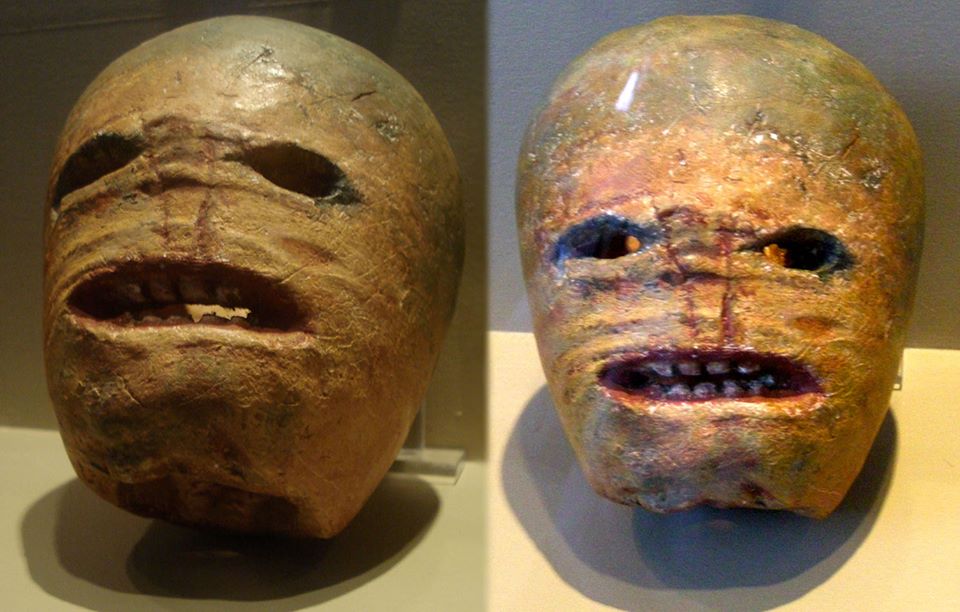
Photo below of Traditional Irish Jack O’ Lanterns in the Museum of Country Life, Ireland.

In modern times trick or treat, children dress in Halloween costumes collect candies, chocolate bars, chips, gum, soda and sometimes a kindly neighborhood dentist will toss a new tooth brush into the little monster’s treat bag. Tricks may be played on the children in lieu of treats.
Samhain in the past, folks dressed as animals hollowed out turnips and placed a lit candle inside it to help the folk see clearly as they made their way to their wealthiest neighbor’s front door and was given soul cakes as payment for blessings and prayers. The soul cake was a basic cake baked with spices such as ginger, cloves, nutmeg, cinnamon and currants marked with a cross to ward off malevolent spooks. Pranks were recorded in the Scottish Highlands as far back as 1736. The Irish loved to play pranks too and began calling Samhain, “Mischief Night.”In southern Ireland In the 19th century, guisers used a hobby horse placing a decorative horse skull in its head while the man covered himself with a sheet under the hobby horse. This was known as Lair Bhan (white mare)He would lead the youth blowing a cow’s horn to farms reciting vereses and the farmer donated food to them to usher in good luck from ‘Muck Olla.’
Vintage postcard of Bobbing for Apples in Public Domain

In North America, turnips were replaced with pumpkins which were easier to carve into Jack O’ Lanterns. Jack O’ Lanterns were used to repel wicked spirits from the folk’s homestead.
Later, folks gathered and snacked on apples and nuts. During Samhain and Halloween folks played games like ‘bobbing for apples’ or ‘apple ducking’ is where an adult would fill a tub of water and place enough apples so that each player had a chance to catch the bobbing apple with their teeth with their arms tied behind them. The first one to catch an apple with their teeth is the winner. Sometimes young couples would play this game where the apple is hanging from a string the first one to bite into it would be the next to wed.
Snap dragon:
was a game that became popular in the 16th century CE.
Illustration below of Halloween Snap Dragon game from 1859 Household Monthly Public Domain.
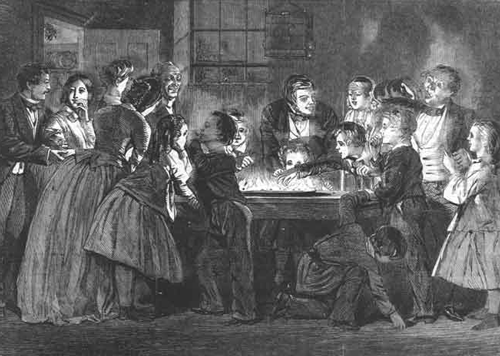
Brandy was heated in a shallow bowl with raisins and then lit with a flame.The lights were turned off for a spooky ambiance. The goal of the game was to pick out the raisins with ones fingers without the flaming brandy burning them and eat the raisins.
Mummer’s theater:

Evolved from mummers and guisers during the mid 18th century.
Folk plays performed by troupes such as St. George and the dragon were performed. One of the earliest versions of a mummer’s play narrative is from 1779, “Morrice Dancers” play in Revesby Lincolnshire. Mummer’s theater is still popular today.
Samhain or Halloween offers so many delightful, activities that is fun to share among family and friends or one may quietly observe in solitude and honor the ancestors, the choice is up to you.
May you all have a Blessed Samhain! Happy Halloween!
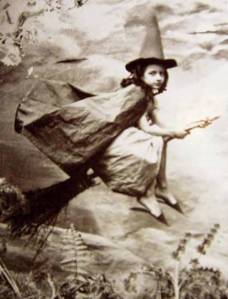
Please remember to keep your pets in on and around Samhain/Halloween for their safety. We all know monsters arise on a full moon. 🙂
Stay safe everyone!

All Nifty Buckles Folklore Fun posts Copyright 2019 All Rights Reserved.
Source & Reference:
- Freeman Philip, Celtic Mythology Tales of Gods, Goddesses and Heroes. Oxford University Press ISBN 978-0-19-046047-1
- Rajchel Diana, Samhain Rituals, Recipes & Lore for Halloween Llewellyn Publications.
-
Rogers, Nicholas (2002). “Samhain and the Celtic Origins of Halloween.” Halloween: From Pagan Ritual to Party Night. New York Oxford University Press ISBN 0-19-516896-8
-
History.com online https://www.history.com/news/what-is-bobbing-for-apples
-
Old photos in Public Domain
 Nifty Buckles (Valerie Hopkins) Author of enchanted tales, folklore & magic • Once famously chased by vampire pumpkins. Brand Architect of The Darwind5 VAWT