

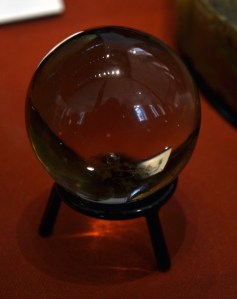
Have you ever been to a fortune teller? If so you may have spotted an attractive Orbuculum also known as a Crystal Ball aligned in the centre of a round table.
The Cunning folk would explain ones’ future events using their clairvoyance and the magical art of scrying also known as crystallomancy, crystal gazing or spheromancy. While using their unique psychic abilities they can view ones future by gazing into the Orbuculum.
Photo below of John Dee’s crystal ball, housed in the British Museum. Photo via Wikipedia Commons
History & Background of the Orbuculum & Aztec Mirrors:
The Celtic Druids were the first accredited to scry the future and observe omens within Beryl balls. During the First Century CE, Pliny the Elder expressed users of crystal balls as soothsayers “Crystallum orbis,” was later penned in Medieval Latin by scribes as orbuculum. It became very popular in the Roman empire by the 5th Century CE.
Once the Roman Empire transformed into the Roman Catholic Church and Christianity took its’ foothold, scrying became a taboo and was condemned by the early medieval church as a heresy.
Overtime spirituality began to blossom once more.
Picture below of Dr. John Dee (13 July 1527 – 1609

Dr. John Dee was a famous consultant to Queen Elizabeth I. He was also well educated and was a notable astronomer, mathematician, astrologer and geographer. He dedicated most of his time to the research of Hermetic philosophy, alchemy and divination of which Crystal balls and Aztec mirrors were used for scrying. During the Victorian era from 1837-1901 Crystallomancy became in demand again. It was noted that Crystal gazing worked best when the Sun was at its most northern decline. The Crystal orb would become clouded right before a vision presented itself within the orb.
The Aztec or Mesoamerican culture also used mirrors to serve as portals into a realm that could be observed but not interacted with. A spiritual dimension. These mirrors were crafted from stone and later Obsidian using Volcano glass to craft mystic, murky mirrors used for scrying. Dr. John Dee had one and it is shown in the British Museum.
At times, Mesoamerican diviners also used bowls of water for scrying.
Dr. John Dee also used scrying tools such as Aztec Mirrors like the one in the photo below
Below: Aztec mirror fashioned from Obsidian located at the British Museum.

Scrying in Folklore:
There are scrying rituals cited in ceremonial magic and are kept through folk tales and superstition.
One particular tradition back in the Victorian era was held that a young woman in a darkened room gazing into a mirror usually at Samhain or Halloween would catch an image of their future husband’s face in the mirror or they would spot a skull symbolizing Death if she was fated to perish before they were able to wed.
Below: Ye Olde Postcard from Halloween past in Public Domain.

Another well known Victorian era folklore was of Bloody Mary where young women were encouraged to walk up a flight of stairs backwards, holding a candle and a hand mirror, in a darkened house. As they gazed into the mirror, they were supposed to be able to catch a glimpse of their future husband’s face. Once in a Blue Moon just by chance one would spot the skull-face of the Grim Reaper instead; this meant that they were fated to die before they married.

Above: Ye Olde Victorian Postcard from the Public Domain
Sources & References:
- John William Waterhouse’s painting “The Crystal Ball,” 1902. for the featured image.
*Northcote Whitridge Thomas. (1905). Crystal Gazing: Its History and Practice with a Discussion on the Evidence for Telepathic Scrying. Moring.
*Aleister Crowley, Adrian Axwirthy. (2001). A Symbolic Representation of the Universe: Derived by Doctor John Dee Through the Scrying of Sir Edward Kelly. Holmes Publishing Group.
*Healy, Paul F.; Marc G. Blainey (2011). “Ancient Maya Mosaic Mirrors: Function, Symbolism, And Meaning”. Ancient Mesoamerica. Cambridge University Press. 22 (2): 229–244. S0956536111000241.
 Nifty Buckles (Valerie Hopkins) Author of enchanted tales, folklore & magic • Once famously chased by vampire pumpkins. Brand Architect of The Darwind5 VAWT